• Skip to main content
  • Skip to secondary menu
  • Skip to footer

Technology Conferences

Technology Events Calendar

  • Technology Events Calendar
  • Add Your Technology Event
  • Market Reports
    • Technology Digest
  • About
    • How to Organize an Informal Tech Event
  • Contact
    • GDPR

Why People Still Attend Technology Conferences, and What Organizers Must Remember

November 16, 2026 By admin

Technology conferences have spent years trying to justify their existence in a world where product launches stream live, technical documentation is instantly available, and a video call can connect almost anyone. Yet people still board planes, book hotels, wear badges and spend entire days walking between sessions. The reason is not that the internet has failed to deliver information. It is that information was never the whole point.

Look at a typical conference lobby. In this photograph, taken in a bright entrance hall with glass walls and sunlight pouring across the floor, the interesting activity is not happening on a stage. A man in a blue polo shirt, with a camera hanging from his neck and a conference badge on his lanyard, gestures while speaking to a woman wearing a striking red hat and a geometric-patterned dress. She stands with her arms folded, listening. Around them, other attendees check their phones, take calls, carry backpacks or drift between conversations. It looks ordinary, almost incidental. And that is precisely what organizers should notice: these unprogrammed encounters may be the most valuable part of the event.
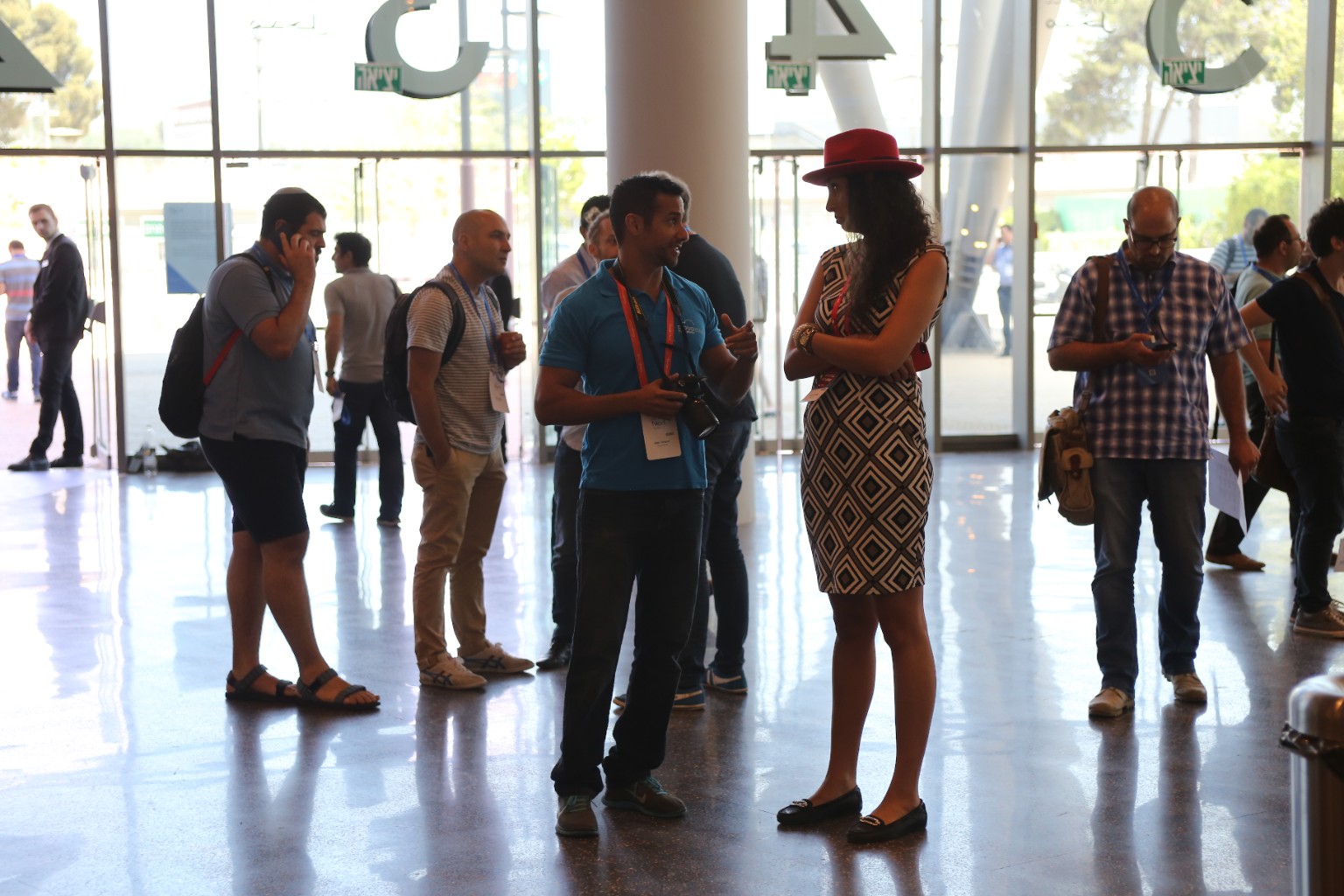
Attendees in conversation in a technology conference lobby
Between sessions, the conference becomes a place for spontaneous conversations rather than presentations.

A keynote can be watched later, often at twice the speed. A product announcement can be read in three minutes. Even technical demonstrations increasingly work better as searchable recordings than as live performances. But meeting a future collaborator, finding someone who has wrestled with the same obscure engineering problem, or having a frank conversation with a customer outside the formal sales process is difficult to reproduce online. Physical presence creates a kind of social bandwidth that no event app has yet managed to replace.

People also attend because they want to calibrate their understanding of an industry. What are engineers genuinely excited about? Which technologies are quietly losing credibility? What do people say about a product when its vendor is not standing beside them? Hallway conversations reveal the difference between a polished market narrative and what practitioners actually believe. In a sector overwhelmed by announcements and AI-generated commentary, that distinction is becoming more valuable, not less.

There is another motivation that organizers sometimes underestimate: the pleasure of belonging. A developer who works alone, a startup founder buried in operational problems, or a technical specialist whose colleagues barely understand their work may find a rare community at a conference. Recognition, curiosity and a sense of shared purpose are legitimate returns on attendance. An event does not need to disguise them as lead generation or professional development.

This changes how conferences should be designed. Organizers often treat the program as the product and everything between sessions as empty space to be filled. They schedule talks back to back, turn foyers into promotional obstacle courses, and measure success by the number of speakers and sessions. But if the human connections are central, the breaks are not interruptions to the event. They are the event.

Give attendees time to talk. Provide comfortable places to sit, acoustically tolerable areas for discussion, accessible meeting spaces, reliable Wi-Fi, power outlets and good coffee without punishing queues. A conference with fewer sessions and better opportunities for conversation can deliver more value than a packed timetable that leaves everyone exhausted. Allow people to linger after a session instead of pushing them immediately into the next room.

Make introductions easier without forcing artificial networking. Clear badges with readable names and affiliations help. Small topical gatherings, informal tables for shared interests and practical workshops give strangers a natural reason to begin talking. First-time visitors need particular attention: an established professional can rely on old acquaintances, while a newcomer may spend two days surrounded by people and still feel invisible. Thoughtful hosts and genuinely welcoming formats matter more than another gamified networking feature.

Respect the attendee’s money and time. Travel, accommodation, tickets and days away from work make participation expensive, especially for independent developers and small businesses. An event that promises meaningful access but delivers little beyond sponsored presentations is asking people to subsidize its marketing operation. Keep commercial sessions clearly identified, protect editorial independence, and make the program specific enough that visitors know what they will actually learn.

Remember, too, that not everyone attends for the same reason. Some want customers, others want jobs, investors, technical answers, collaborators or simply a chance to see where their field is going. Design different routes through the event without segregating people into rigid categories. The most surprising encounters often occur between participants who would never have selected one another in a networking application.

And do not confuse attendance statistics with value. A crowded exhibition hall photographs well, but it tells little about whether visitors made useful contacts or learned something they could not obtain elsewhere. Ask people weeks later whether a conversation led to a project, whether an idea changed their work, or whether they would pay to return. Those answers are more revealing than scanned badges and app downloads.

Finally, protect the atmosphere. Natural light, straightforward wayfinding, adequate space, accessibility, quiet corners and even the possibility of stepping outside make a difference. Conferences are physically demanding. The person who has spent hours standing, listening and navigating noise is not in the best condition to have a thoughtful conversation. Hospitality is not a decorative extra; it shapes the quality of interaction.

The enduring attraction of technology events is, paradoxically, not primarily technological. It is the chance to meet people in the same place, at the same time, without every exchange being scheduled or optimized. The speaker onstage may supply the reason to buy a ticket. The conversation in the lobby is often the reason to come back. Organizers who understand that distinction will have a much better chance of creating events worth attending.

Filed Under: News

Footer

Recent Posts

  • Why People Still Attend Technology Conferences, and What Organizers Must Remember
  • SC26 Supercomputing 2026, November 15-20, McCormick Place, Chicago
  • MWC Doha 2027, November 15–17, Doha, Qatar
  • A3 Business Forum 2027, January 18-20, Signia by Hilton Orlando Bonnet Creek, Orlando
  • IAMPHENOM 2027, April 20-22, Pennsylvania Convention Center, Philadelphia
  • Channel Partners Conference and Expo 2027, March 15-18, The Venetian, Las Vegas
  • Fintech NerdCon 2026, November 18-20, San Diego Convention Center, San Diego
  • HLTH 2026, November 15-18, The Venetian Expo, Las Vegas
  • electronica 2026, November 10-13, Messe München, Munich
  • KIOXIA Forum 2026, November 26, TODA Hall and Conference Tokyo, Tokyo

Media Partners

  • API Coding
  • App Coding
  • S3H.com
RFC 9457 Problem Details Gives API Errors One Shape Instead of Fifty Ad Hoc JSON Bodies
Idempotency Keys: How One Header Stops a Retry From Charging a Customer Twice
A Tiny ETL Binary Competes With curl, jq and SQLite in a Cron Job, So Build It That Small
An AI Agent Flight Recorder Belongs in One Portable File, the Way HAR Did It for HTTP
Benchmarking MCP Servers and Stateful API Workflows: Latency, Throughput and Tokens per Call
Diagnose a Slow API From One Request: DNS, Connect, TLS, Server Wait and Transfer
Finding API Endpoints, Tables and Flags Nobody Uses Takes Code and Traffic Together
Fuzzing MCP Servers: Generate Bad Arguments From the Tool Schema and Watch What Breaks
Give Any API a History: Poll It, Hash It and Query Old Versions With SQL
Infer Your API's Real Contract From Traffic, Then Diff It Against the Docs
Testing Optimistic Quantum Fourier Transform Circuits With OQFT and Qiskit
Bluehost AI Builder Turns a Prompt Into a Website or a Booking App and Takes the AI App Builder Fight to Hosting Customers
Claude Code on GitLab vs GitHub: Thinner Integration and a Fifth of the Free CI Minutes
How k4i.com Publishes Posts Unattended With Small AI Models, Groq and GitHub Actions
How to Ship In-Browser AI Apps With No Server and No Inference Bill
Microsoft Authenticator Android Flaw Shows Why Apps Must Verify Who Is Calling Them
Zero-Budget AI Apps Work Best as Self-Feeding Sites, Not Open Tools
A Useful Software Primitive Should Be Easy to Explain and Hard to Replace
Apple's US Link-Out Fee Is Zero Until a Judge Sets It, and Apple Is Asking for Up to 15%
20 Primitive Project Ideas: Tiny Go Engines That Do the Essential 10% of Redis, Kafka and Etcd
KIOXIA and Dell Put 157 PB of Flash in One 42U Rack and Shift the Data Center Bottleneck to Interconnect
Ocient Raises 100 Million Dollars for AI on Petabyte Data as Cerabyte Ceramic Storage Passes S3 Tests at CERN
OpenAI GPT-6 Cyber Finds 81 High-Severity Firefox Flaws and Shows Why Patch Backlogs Are About to Get Worse
Employee Offboarding Is Where Access Control Actually Fails
Open Source Projects Should Ship Without Their Maintainers
Round 7 is finished: V1, T5 and F5 are merged on main
AltSql Gives IoT Devices a 15 KB Database That Keeps Working When the Link Drops
BareProxy Is a Small Go Web Server and Reverse Proxy That Explains Every Routing Decision
Precomputing Keeps Dashboard Answers Ready in a SQLite File as the Data Arrives
Preconfiguration Writes Coding Agent Setup Files From One Spec and Tests Them on a Clean Machine

Media Partners

  • Technologies.org
  • Blockchaining.org
  • Cybersecurity Market
LangChain Raises $300 Million at a $3 Billion Valuation to Build Out LangSmith Agent Platform
OQFT Shows Where the Quantum Fourier Transform Can Get Shallower
MemryX MX3+ Targets 1 POPS for Edge AI as Tianji Shows a 21-Joint Robot Hand at CoRL and Appear Starts Solid-State Battery Pre-Production
Adobe MAX 2026 Opens Photoshop and Premiere to Outside AI Agents and Deepens Its Google Partnership
Zendesk Launches Outcome AI Platform and Drops Seat Limits From New Plans
Otto One Is a $599 Screenless Computer Built for an AI Agent to Live On
PuppyGraph Raises $10 Million Series A to Let AI Agents Query Thousands of Tables as a Graph
Lumbra Raises $25 Million to Take AI Agents From Top-Secret Networks to Regulated Industries
Graphon Labs Raises $35 Million Series A to Give AI Agents Memory That Persists
Bay Exits Stealth With $50 Million to Check Every AI Agent Action Before It Runs
BitGo (BTGO) Takes a Strategic Position in Aptos Token APT on Top of Its Custody and Staking Work
Circle (CRCL) and Global Citizen Will Pay Move Afrika Concert Vendors in USDC, Starting in Rwanda in 2027
DriveWealth Wins MiCA Authorization From the Bank of Lithuania, Putting Crypto and US Stocks Under One EU License
BitGo Reports a 44 Million Dollar Q3 Profit From Its Own Bitcoin as Metaplanet and BTC Inc Plan a Tokyo Bitcoin Conference for 2028
Securitize Buys River One to Lend Stablecoin Money Against Real Assets as Avalanche Is Picked for NYSE's Tokenized Securities Platform
Hawkeye Digital Will Tokenize Its Own Common Stock on Ethereum With Securitize
Binance Breach Hits 6.3 Billion Dollars as Tether and Circle Freeze the Stolen Stablecoins
Janus Henderson Launches JQQQ, a Tokenized Nasdaq-100 Fund on Stellar for Non-US Professional Investors
Ripple Signs Robinhood, BNY and C2FO in One Day as RLUSD Moves Into Brokerage, Custody and Trade Finance
Robinhood Crypto Revenue Falls 55% to $120 Million in Q3 2026 as Event Contracts Pull Ahead
Tanium Converge 2026, November 16-19, ARIA Resort and Casino, Las Vegas
IBM and CrowdStrike Move to Control Enterprise AI Agents
Anyday Security Launches ExploitTotal.ai With 200 AI-Built Exploits, 72% for Bugs That Had No Public Exploit
Redspin Earns ISO 17020 Accreditation as One of the First CMMC Assessors as DQS Certifies Samsung Display Automotive Cybersecurity
Vanta Launches the Vanta Trusted Network to Turn Compliance Partners Into Recurring GRC Practices
AppGate Earns the Only Perfect Score for Zero Trust Architecture Integrity in the GigaOm ZTNA Radar
Bitdefender Replaces TrafficLight With Web Sage, an AI Browser Advisor That Explains Why a Page Is a Scam
Cyera, Obsidian and Druva Ship New Controls for AI Agents as Security Vendors Race to Govern What Agents Do
Rubrik (RBRK) Adds Surgical Recovery for GitHub and Azure DevOps and Extends Backup to BigQuery and AWS Applications
Attackers Exploit New Flaws Within 24 Hours While 44 Percent of Companies Need Four Days to Patch, Lumen and Azul Find

Copyright © 2022 TechnologyConference.com

Media Partners: Technologies · Market Analysis · Market Research · Exclusive Domains · Photography · Referently · Transportational · Renewability